

Uranus expresses itself through the quality of “Moist”, which is by far predominant, combined with the quality of “Hot”. Its strong expression as “Moist” gives Uranus an extremely malleable nature, that is, a receptiveness to everything that is innovative and different from the usual. This endows natives who have a strong Uranian presence in their natal astrological theme with an original mind, which tends to form opinions and view things from unconventional perspectives.
If the Sun is the symbol of order, Uranus is the planet that questions it. Therefore, natives who have Uranus in the House or conjunct the Ascendant tend to be people with an eccentric—or at least divergent—view of things and easily become convinced that their ideas are better than those of others. Whether this is good or bad will depend on several factors, including the aspects formed by Uranus. If, for example, a conjunction between the Sun and Uranus occurs in the House, it will be difficult for the native to accept social norms, since Uranus will always question the order of things. As this conjunction is particularly explosive because of the intrinsic nature of these two planets, a native with this configuration will not concern themselves with constructing alternatives to what they call into question: they will tend merely to try to destroy it.
Very different will be the case if Uranus is in the First House and receives, for example, a trine from the Sun in the House. Although, in this case, the position of Uranus leads the native to question the established order, the trine to the Sun makes them concerned with how to improve and adapt the system they call into question. Naturally, these conclusions must be modulated by the signs in which those aspects occur: it is one thing for the conjunction to occur under the influence of the Fire of Aries, and quite another for it to occur in the Dry and Cold realm of Virgo.
Uranus is said to be the higher octave of Venus.[1]. In other words, it is of a similar nature, but raises the vibrations of Venus, qualitatively, to a higher level. Venus expresses love towards others; Uranus extends that love to everything that exists and spiritualises it. This can have drastic consequences, for if Venus is poorly placed, for example in Scorpio, the native will experience things in a very “physical” way; by this I mean that they become sensual in the sense that they experience things disproportionately, leading them to act accordingly. With Uranus, this becomes a cult, and this attachment to the senses may lead the native to highly undesirable extremes. For example, the presence of Uranus in Leo in the House, square Venus in Scorpio in the House, could be regarded as the signature of someone who seeks sexual pleasure for its own sake, without any limits or feelings of love. If, in addition, Saturn were conjunct Venus, this would add an element of permanent dissatisfaction to the configuration, which the native might seek to compensate for through aberrant acts, representing a complete distortion of the libido.
A very fortunate position for Uranus is undoubtedly the House. If this position occurs in a sign in which Uranus is dignified and it is well aspected, for example, to Mercury in a good cosmic state in the House, then the native’s mind will be tremendously creative and their reasoning quick and acute, which they may put at the service of research in the Exact Sciences.
Uranus rules:
- Anatomically, the nervous system and the pituitary gland.
- In vital functions, the distribution of energy through the nervous system. As it rules the hypothalamus and the pituitary gland, it also plays a role in the opening of the spiritual senses[2].
- In professions, all those requiring originality and a creative mind. Mathematicians and physicists. Astrologers and astronomers. Astronauts. Computer programmers. Computer or systems engineers. Electricians.
- In days of the week, Friday[3].
- In colours, black and all dark colours.
[1] Some astrologers mistakenly maintain that Uranus is the higher octave of Mercury, which makes no sense, since the Primitive Qualities of Mercury and Uranus are incompatible.
[2] Segundo algumas Escolas de Pensamento, a matéria física organiza-se, não em 4, mas em 7 estados distintos. Falamos em “abertura dos sentidos espirituais” ao conjunto de processos que nos permitem alargar o nosso espectro visual e nos tornam sensíveis a essas realidades.
[3] Tendo em conta que Urano é a oitava superior de Vénus.
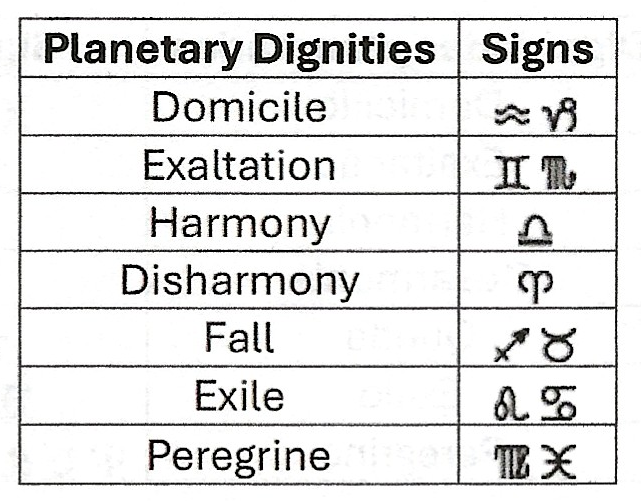
Planetary Dignities of Uranus
Add comment
Comments