

Mars expresses itself through “Dry” and “Hot”, with the former quality predominating. This nature confers upon it vigour, passion, perseverance, determination in pursuing its goals, decisiveness and the ability to bring the projects in which it is involved to fruition.
Among the Ancients, it was known as the “Lesser Malefic”, by comparison with Saturn, the “Greater Malefic”. Nowadays, many astrologers, me included, take a different view. Mars’s “bad reputation” stems from the consequences of its action when it forms disharmonious aspects with other planets.
When Mars is in a poor cosmic state, by which I mean when it is weak in a sign and/or forms conflicting aspects with other planets, vigour turns into exhaustion, passion and perseverance give way to obstinacy, and decisiveness degenerates into rashness. When dignified, Mars signifies courage, strength and boldness; when poorly placed in a sign, it signifies weakness and cowardice. In tense aspects, Mars becomes violent and destructive.
A few examples may help clarify the nature of Mars and the way in which its signature manifests itself in real life. Let us consider Mars square Saturn, with Scorpio ruling the House and Capricorn ruling the House. The House tells us about the native’s health, while the House concerns their genetic inheritance. This configuration may indicate that the native was born with problems involving either their bone structure (Saturn rules the skeleton) or their iron levels (Mars restricted by Saturn). I am not considering here other aspects that may reinforce or mitigate these conditions. For example, a strong House may create conditions under which these limitations can be alleviated or even overcome.
At the risk of being discredited—and, once again, bringing Astrology into disrepute—the astrologer must always exercise the utmost caution when discussing an astrological theme. They should never look only at this or that aspect of the theme: they must perceive it as a whole, which may sometimes be difficult. In practice, one will never find a theme containing only good things and another containing only bad things. But in the end—and they will be judged by this—it will be the astrologer’s responsibility to draw the overall conclusion and advise accordingly, based on the aspects they have selected as the most relevant.
Let us now imagine Mars conjunct Uranus in the House. We shall consider two cases: when the conjunction occurs in Scorpio and when it occurs in Aries. To facilitate understanding, I shall not consider any other aspects that may be involved. In the first case, both planets are dignified, but the effect of Uranus upon Mars in Pluto’s realm makes it explosive. These are natives capable of withstanding great pressures outwardly, but when they react, they will do so suddenly, with disproportionately violent and potentially lethal force. They are, in fact, people subject to considerable emotional strain and are very sexually active. In the second case, we have a native who is permanently in a state of agitation. They are rash and obey no rules other than their own desires. And because I am considering the conjunction in the First , which tells us about the constitution of the body, it is also very likely that the native will be prone to periods of illness manifesting through high fevers.
One final example: Mars conjunct Neptune. This is the typical example of a native who is guided by chimeras. Indeed, dreaming is not a bad thing. But dreaming while disregarding reality may lead to disappointments that could otherwise have been avoided. In this conjunction, Mars amplifies the impressions conveyed by Neptune and, as such, distorts them, causing the native’s actions to be directed towards unrealistic projects, or projects whose fulfilment exceeds the native’s capabilities. Since Neptune is the preferred gateway for communication with suprasensible worlds, the energy of Mars exposes the native to the influence of undesirable invisible entities, turning them into a spiritist, hostage to the agents of those entities, whom they will have difficulty controlling. Western Medicine usually refers to these clinical conditions as epilepsy. Of course, not everyone who has Mars conjunct Neptune is epileptic; everything depends on the sign and in which the aspect occurs (and on the rest of the astrological theme).
Mars rules:
- Anatomically, the brain and the head in general. The upper jaw. The male genital organs.
- In vital functions, the metabolic processes involving iron, such as those that lead to the production of haemoglobin.
- In professions, all those requiring good physical performance, such as athletes in any sport. Soldiers or professions related to warfare, such as weapons manufacturing. Mechanical engineers or those involved in the iron and steel industry, working with iron. Butchers, as well as veterinarians and surgeons. Occultists.
- In days of the week, Tuesday.
- In colours, red.
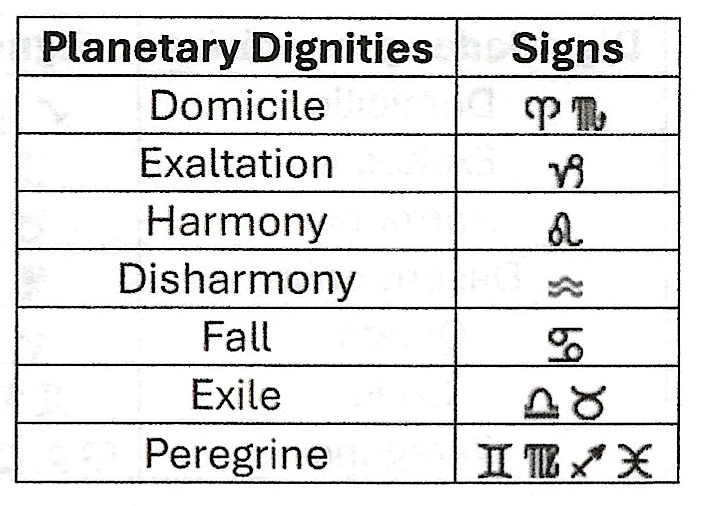
Planetary Dignities of Mars
Add comment
Comments