

For each musical resonance box, there are strings that are suited to it and therefore produce harmonious sounds that are pleasing to us, while others are unsuitable and produce, at best, distorted sounds that are nothing more than noise.
The relationship between planets and signs is analogous in nature. Each sign possesses a specific vibrational quality, identified by its Primitive Qualities. The same applies to each planet. Thus, for every planet, there are signs which, by their nature, provide excellent means of expression for the qualities symbolized by that planet, while others — lacking affinity with the planet situated in them — are unable to express its planetary qualities or express them in a distorted manner.
Depending on the degree of compatibility or incompatibility between each sign and the planet situated in it, the following planetary dignities (and debilities) are established, listed here in descending order of importance:
Planetary Dignities and Debilities
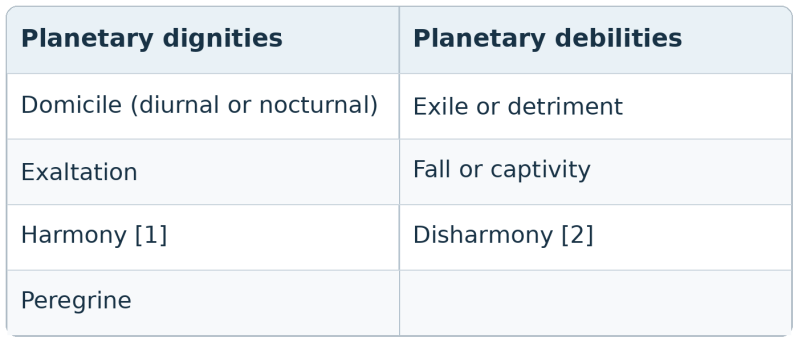
n domicile, a planet expresses all its qualities. In exaltation, this expression takes place mainly on a spiritual level; naturally, these qualities will also manifest themselves on a physical level. Harmony reflects precisely this: although planetary vibrations express qualities different from those of the sign, they are of the same nature and can easily express themselves through it.
An example may clarify what I have written. Mars has one of its domiciles in Aries, is exalted in Capricorn, and is in harmony in Leo. Mars symbolizes willpower, strength — particularly physical strength — and a combative spirit.
When Mars is in Aries, it symbolizes the warrior who advances fearlessly against his enemy, proclaiming his determination to the winds; when in Capricorn, he becomes the judoka, never losing his composure or coolness, however difficult the situation he faces, yet remaining no less determined or effective. His strength is primarily intellectual; he assesses the situation and acts only to the extent strictly necessary.
Mars in Leo lacks the exuberance of Mars in Aries and the calculating nature of Mars in Capricorn; instead, it possesses nobility of conduct, being incapable of confronting an enemy by taking advantage of any a priori superiority. The concept of honour takes precedence over the need to fight. He wants to win the battle, but not at any cost. Mars has its nocturnal domicile in Scorpio. This position does not represent the audacious warrior, the formidable force that crushes everything in its path, but rather the soldier who, lying in ambush, waits for the precise moment to attack. He is not exuberant: he is cold and silent, but no less effective.
In planetary debilities, there is a distortion of the planets’ qualities; the Moist quality of Libra or Aquarius is by no means an excellent medium for expressing the Dry quality of Mars. In planetary debilities, one of the sign’s qualities is opposite to the planet’s predominant quality, while the quality common to both undergoes a reversal of predominance.
Planets are peregrine when they are situated in signs with which there is no adequate correspondence between their respective Primitive Qualities.
To better understand this situation, let us imagine two cogwheels whose teeth have different configurations. Although both are cogwheels, their teeth cannot mesh with one another, preventing the mechanism from functioning as a whole.
Something similar occurs in the relationship between planets and signs: even when they possess Primitive Qualities of the same nature, the different proportions in which these qualities manifest themselves may prevent their compatibility.
This is the case with Mercury and Capricorn. Both possess the qualities Dry and Cold, but in different proportions. For this reason, Mercury is peregrine in Capricorn.
[1] It is not customary to consider a planet to be in “harmony” or “disharmony”. This classification was taught to me by Francisco Marques Rodrigues (Salreu, 1899 – Lisbon, 1979), former President of the Rosicrucian Fraternity of Portugal, during private lessons that I had the honour of receiving.
[2] See previous note.
Add comment
Comments