

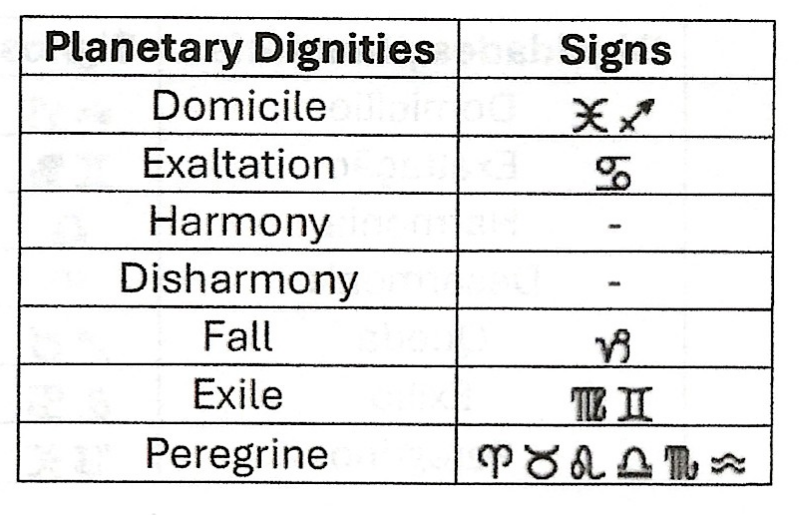
Neptune expresses itself through the quality of “Cold”, which is predominant, combined with the quality of “Moist”. This gives Neptune a nature that is more passive than active, suited to the receptive function assigned to it. Indeed, as ruler of the pineal gland, Neptune functions as a true gateway of communication between the visible plane and the suprasensible planes. Depending on the planet’s aspects, this may be something very beneficial or a source of many concerns. Neptune’s dignity in the sign in which it is placed indicates how easily this gateway opens or closes; its aspects describe the manner in which it opens and the world into which it opens.
Let us consider Neptune in Pisces. Let us even suppose that this Neptune is conjunct the Moon, also in Pisces, and in the House. It will be one thing if the conjunction receives a trine from the Sun in the House or at least forms no aspects; it will be quite another if Neptune forms a square with the Sun (or Saturn) in the House. In this case—because the House tells us about genetic material—the constitution of the native’s bodies[1] will facilitate the development of mediumship[2], making the native vulnerable to undesirable entities. Since the House also represents the family, and particularly the mother, the native may have inherited these mediumistic tendencies from their mother. We may expect these tendencies if these aspects occur in the House.
Neptune is the higher octave of Mercury[3]. Just as Mercury is the bearer of the light of the physical Sun, Neptune is the bearer of the light of the spiritual Sun, which Western Tradition commonly calls Vulcan. Being of a nature identical to Mercury, and since Mercury is one of the planets involved in the way we reason—it is responsible for our capacity for analysis—it is to be expected that Neptune is also involved in this process. And indeed it is: Mercury rules the coherence of our reasoning, the Moon rules our capacity for spatial perception, imagination and memory, and Neptune rules our capacity to coordinate ideas and form explanatory models of things.
In the example of the configuration I cited above (Neptune square the Sun or Saturn), it is therefore natural that a native under those aspects may be unable to mentally integrate the impressions received through the senses. In harmonious aspects, Neptune signifies clairvoyance; in disharmonious aspects, it signifies illusion and an incorrect conceptualisation of the Reality surrounding the native. We can thus understand what may happen when Neptune is in a poor cosmic state in each of the Houses. If it is in the House, the native may fall victim to fraud; if it is in the House, they will attract unreliable marriage partners, and so forth.
Neptune rules:
- Anatomically, the pineal gland.
- In vital functions, the senses that enable us to perceive states of matter and realities that are normally inaccessible[4] (together with Uranus).
- In professions, all those related to the human psyche, such as psychologists and sociologists. Professions related to Religion. Illusionists.
- In days of the week, Wednesday[5].
- In colours, dark blue.
[1] The term is deliberately used here in the plural. According to some Schools of Thought, Man is constituted by more than one body—specifically, four bodies—which serve as vehicles for the expression of the Ego.
[2] Western Medicine usually refers to mediumship as epilepsy.
[3] Many astrologers mistakenly claim that Neptune is the higher octave of Venus, which makes no sense, since the Primitive Qualities of Neptune and Venus are incompatible.
[4] According to some Schools of Thought, physical matter is organized into seven distinct states, rather than four. Neptune is the planet that enables us to develop senses through which we can perceive objects existing in these states of matter.
[5] Considering that Neptune is the higher octave of Mercury.
Planetary Dignities of Neptune
Add comment
Comments