

For two planets to be said to be in a particular aspect, they do not need to form exactly the corresponding number of degrees; that is, two planets that are not exactly 120° apart but, for example, 123° apart are still considered to be in trine. Different orbs of influence are allowed for each type of aspect and according to the planets involved. The values of these intervals are currently a matter of debate among astrologers.
Although the influence is greatest when the angle is exact and corresponds to the values given in the table above, a certain interval of influence, or orb, is established for each angle and for each planet, within which a planetary influence may be expected.
In Astrology, three types of aspects should be considered or, if preferred, there are three distinct levels of strength to be considered for each aspect:
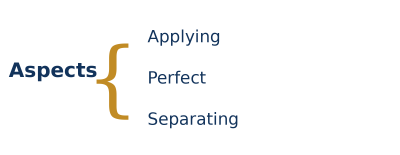
In the case of conjunctions, oppositions and trines, an aspect is considered exact if the difference between the angle formed and the exact aspect does not exceed 1°; in the case of sextiles and squares, aspects are considered exact if the angles between the planets do not deviate by more than 0.5° from the exact aspect; and in the remaining cases (minor aspects), when that deviation does not exceed 0.25°.
In natal astrological themes, exact aspects are those whose influence is most noticeable. What I mean is that a trine between the Sun and Jupiter is stronger the smaller the deviation from 120° between the planetary longitudes. Without taking other types of factors into account, a trine—whether exact or not—is always stronger than, for example, an exact semi-sextile. In a progressed astrological theme, while an aspect is exact, the probability of the aspect manifesting as an event is high.
An aspect is said to be “applying” if it becomes exact at a time a posteriori to that for which the astrological theme was erected; otherwise, the aspect is said to be “separating”. The degree of effectiveness of an aspect increases as it approaches exactness and decreases as it moves away from the exact aspect.
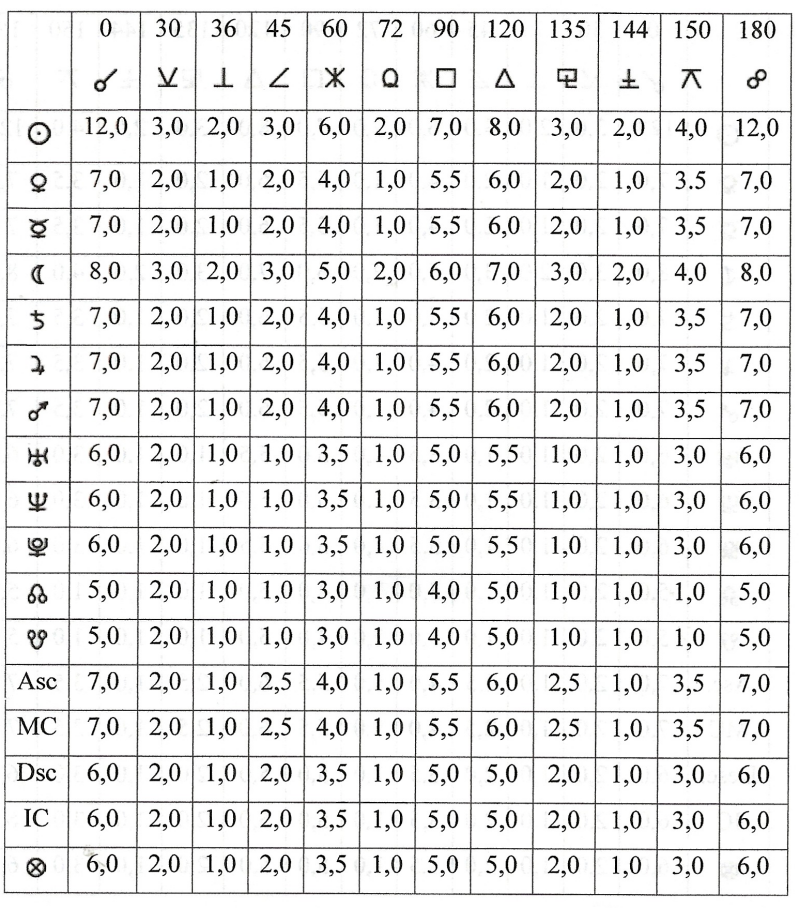
The astrological orbs to be adopted are a matter on which there is no consensus; therefore, the program allows the user, within certain “limits of reasonableness”, to define the orbs they consider most appropriate. Obviously, it would make no sense, for example, to define an orb of 5° for a trine involving Mars while simultaneously defining an orb of 6° for its sextile.
From my astrological practice, I have arrived at the values set out in the following table, which I use in the Astrological Themes program of Symphonia Astrologica®.
Planetary Orbs for Each Aspect between Ecliptic Longitudes
Add comment
Comments