

The Moon expresses itself through “Cold” and “Moist”. This duality makes it capable of governing memory in all its forms, as well as the capacity for spatial perception and imagination.
The Moon represents the family and its traditions and, in a broader sense, the customs and practices of the country in which we are reborn, or rather, the way in which we relate to them. It represents the mother and all women in general who will form part of the native’s life. The Moon also tells us about the native’s emotional life: whether they are someone who controls their emotions well—harmonious aspects between the Moon and Saturn may facilitate such control—or whether they are unable to control them and react in ways in which those emotions manifest abruptly and disruptively (tense aspects between the Moon and Mars). For example, the presence of the Moon in the House —particularly if it is poorly aspected to Mars, Jupiter, Uranus or Neptune—may indicate emotional fickleness, with all the inconveniences that this may entail.
It has already been stated that the Moon is associated with memory. But because of its Cold and Moist nature, and therefore passive, if aspected to Neptune, it may indicate an ability to perceive realities that are normally invisible. Tense aspects between those planets do not eliminate this possibility; however, the experiences associated with such perceptions will be difficult for the native to control (involuntary clairvoyance and/or mediumship).
The Moon in the House or in aspect to it suggests a strong maternal influence upon the individual. Whether this influence is positive or negative depends, among other things, on the type of aspects it forms. In female astrological themes, the presence of the Moon in the House, poorly aspected by Mars, Saturn or Uranus, is an indicator of irregular menstrual cycles.
Another important position is the placement of the Moon in the Twelfth . According to some Schools of Thought, Man possesses, interpenetrating his dense body, another body composed of physical matter in states subtler than the gaseous state, which some call the vital body[1]. The Moon also has a very particular affinity with the vital body, and therefore, if the Moon directly or indirectly rules the House and is poorly aspected, for example to Jupiter, the vital body will tend to dissipate its energies very easily, particularly when the body is immersed in water, since the Moon rules liquids in general. If, at the same time, the Moon is determined towards the Eighth , there is a risk of drowning.
One final note: in a secondary direction, lunar aspects assume their full importance.
A Moon rules:
- Anatomically, the stomach, the breasts, the lymphatic system, the endocrine glands and all the secretions they produce. The left side of the body in general.
- In vital functions, digestion. The process of gestation and the menstrual cycle.
- In professions, all those involving interaction with the public, chemists or pharmacists. Cooks.
- In days of the week, Monday.
- In colours, white, silver and sky blue.
[1] The concept of the vital body exists under various names and is shared by several Schools of Thought, such as the Rosicrucian Fellowship, the Theosophical Society and the Anthroposophical Society. This concept also exists in Chinese Medicine.
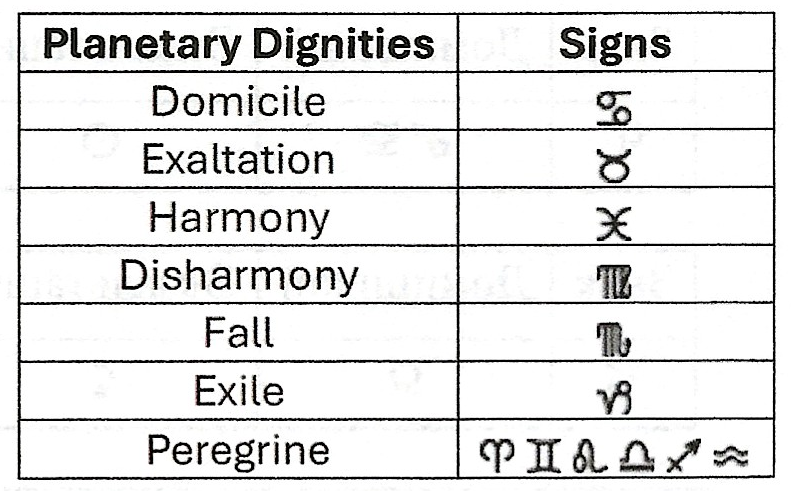
Planetary Dignities of the Moon
Add comment
Comments