

The celestial equator and the ecliptic intersect, defining two points on the celestial sphere: the vernal point (or 0° Aries) and the autumnal point (or 0° Libra). The Zodiac is a band of the celestial sphere centred on the ecliptic, in which the apparent motion of the Sun and, generally, the planets of the solar system is observed. In Astrology, the Zodiac is traditionally considered to be divided into 12 sectors, which constitute the 12 signs of the Zodiac.
In an astrological theme, it is necessary to orient the horizon of the place of birth in relation to the celestial sphere, determining the planetary positions relative to that horizon. The positions of the planets can be measured in various coordinate systems, namely in ecliptic coordinates, through ecliptic longitude and latitude, and in equatorial coordinates, through the planet's right ascension and declination. In Astrology, ecliptic longitude, which takes values in [0°, 360°[, and declination, which takes values in the interval [-90°, +90°], are used.
Equivalently, we can express the ecliptic longitude of a planet in terms of signs. The signs are counted from the vernal point: 0° Aries. Aries is followed by all the other signs: Taurus, Gemini … up to the 12th sign, Pisces. In other words, the concept of a sign is not indispensable for practising Astrology! Saying that a particular planet has an ecliptic longitude of 50° is the same as saying that it is at 20° Taurus.
The signs are a way of classifying ecliptic positions; they are not the constellations!
It is not known exactly how the concept of a sign arose. It is known that the division of the Zodiac into twelve equal signs developed in Babylonian astronomy and was subsequently adopted by Greek astronomy. The only thing I can add in this regard is that it is a classification system that greatly facilitates the understanding and assimilation of the characteristics of planetary influences determined by their positions.
Regardless of the historical origin of their names, the signs of the tropical Zodiac are geometric sectors of 30°, defined from the vernal point, whereas constellations are regions of the sky associated with groupings of stars.
The precession of the equinoxes causes the tropical signs to shift relative to the constellations over the centuries.
One final note: in the (pseudo-)Astrology practised so widely, it is customary to identify a person with a sign: someone was born on 1 October, so they are Libra, immediately followed by a ready-made formula, supposedly universally valid for all Libras on the planet! What is overlooked is that this refers only to the position of the Sun, in this case with an ecliptic longitude between 180° and 210°. And where was Venus? And Mercury? And the other planets?
An astrological theme is a representation of the Sky at a particular moment and place on Earth, characterised by a specific astronomical configuration, far more complex than the mere position of the Sun in a sign!
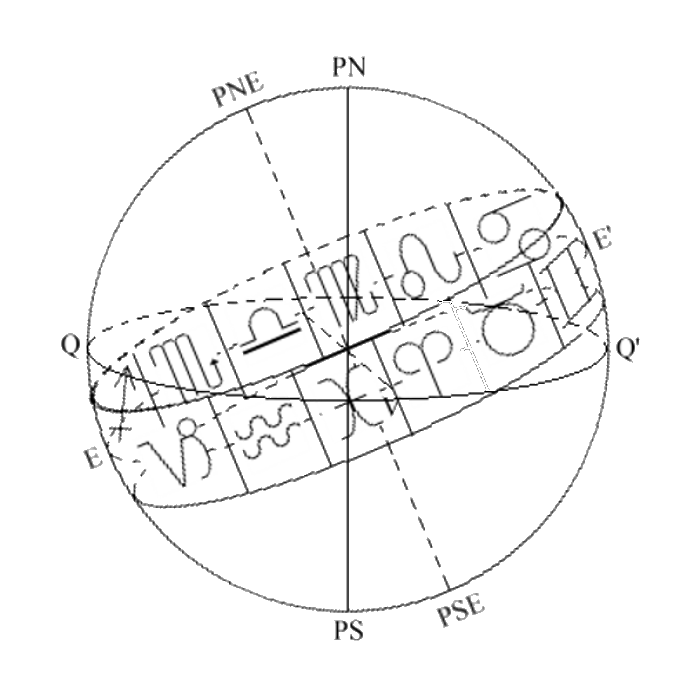
The Zodiac
Add comment
Comments