

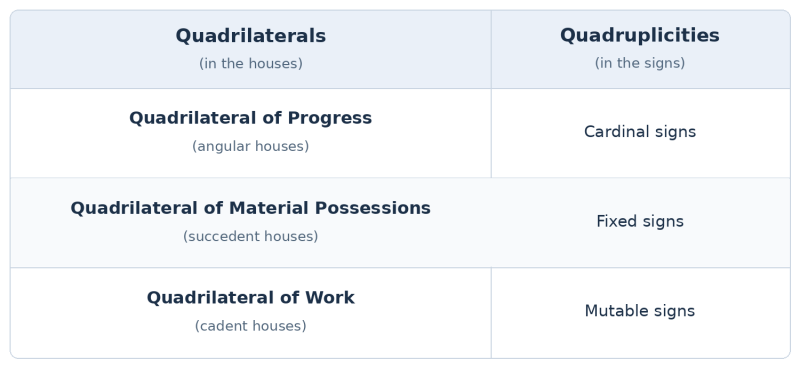
We designate as quadruplicities the three groups of four signs that express the same mode of manifestation of the Primitive Qualities. According to this mode of manifestation, the signs are divided into cardinal, fixed and mutable.
The cardinal signs are characterised by the impulse to initiate and set action in motion; the fixed signs, by the tendency to preserve, stabilise and ensure continuity; and the mutable signs, by the capacity for adaptation and transformation.
We call houses I, IV, VII and X angular houses in an astrological theme. In these houses, planets are said to be accidentally dignified, and their action, according to the nature of the signs in which they are situated, is more pronounced, though not necessarily in a positive way. The group of angular houses constitutes what we call the “Quadrilateral of Progress”.
We call houses II, V, VIII and XI succedent houses in an astrological theme. The influence of planets situated in succedent houses is not as visible — that is, as immediate — as the influence of planets situated in angular houses. Succedent houses tell us about what the individual adds to themselves, whether through construction or acquisition. The group of succedent houses constitutes what we call the “Quadrilateral of Material Possessions”.
We call houses III, VI, IX and XII cadent houses in an astrological theme. In these houses, the influence of the planets situated there is less visible, which does not mean that it is less important. In general, we may say that cadent houses represent the consequences of what each individual is (Quadrilateral of Progress) and what they acquire (Quadrilateral of Material Possessions). From these two determining factors arises what each of us does, thereby shaping our own destiny. For this reason, the group of cadent houses is known as the “Quadrilateral of Work”.
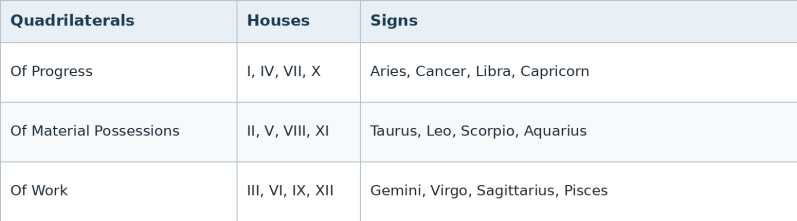
Relationship Between Quadrilaterals and Quadruplicities
Add comment
Comments