

The astrological circle is a representation of the ecliptic, whose orientation relative to the place of observation is determined by the plane of the horizon and the local meridian. The intersection of these planes with the ecliptic makes it possible to define the four fundamental angles of the astrological circle: the Ascendant (Asc), the Descendant (Desc), the Midheaven (MC) and the Imum Coeli (IC).
The Midheaven (MC, beginning of the tenth house) and the Imum Coeli (IC, beginning of the fourth house) correspond, respectively, to the ecliptic longitudes of the points where the ecliptic intersects the upper and lower branches of the local meridian. The meridian plane divides the Celestial Sphere into two hemispheres, eastern and western. The plane of the horizon, in turn, divides it into two hemispheres, upper and lower.
The Ascendant (beginning of the first house) and the Descendant (beginning of the seventh house) correspond to the intersections of the ecliptic with the eastern and western horizon, respectively. These four points delimit the four fundamental quadrants of the astrological circle, each comprising three houses. However, the ecliptic amplitudes of these houses are not generally equal.
In the Placidus house division system, the determination of the intermediate house cusps is based on the temporal division of the diurnal and nocturnal semiarcs of points on the ecliptic.
Consider the apparent diurnal motion of a celestial body, for example, the Sun. From its rising on the eastern horizon to its passage across the upper meridian, the body traverses the first half of its diurnal arc. From the upper meridian to its setting on the western horizon, it traverses the second half. Similarly, the nocturnal path comprises two semiarcs: from the western horizon to the lower meridian and from there to the eastern horizon.
Each of these four semiarcs is divided into three equal parts in terms of travel time, rather than angular amplitude measured along the ecliptic. Since the duration of the semiarcs depends on the declination of the celestial body and the latitude of the place, each third does not necessarily correspond to two hours.
Thus, in the first diurnal semiarc, between the Ascendant and the MC, the points corresponding to one third and two thirds of the travel time mark, respectively, the positions associated with the cusps of the twelfth and eleventh houses. The same procedure is followed for the remaining semiarcs, considering the intervals between the MC and the Descendant, between the Descendant and the IC and, finally, between the IC and the Ascendant.
It is important, however, to clarify that, in the actual calculation of house cusps using the Placidus method, one does not simply follow the motion of a single celestial body. Instead, one seeks to determine points on the ecliptic whose positions correspond to the established temporal divisions. Since these points generally have different declinations, their respective semiarcs also have different durations. For this reason, determining the intermediate house cusps requires solving astronomical relationships specific to this house division system.
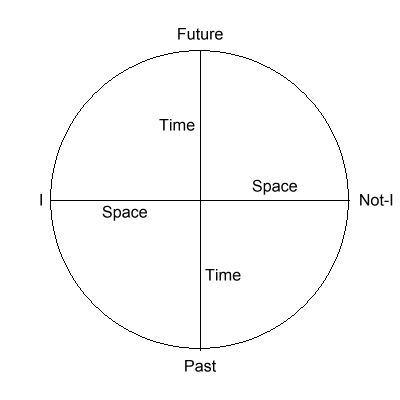
Spatiotemporal Organization in an Astrological Theme
Schematically, an astrological theme is determined by a spatiotemporal frame of reference, in which the Self establishes a spatial relationship with the Non-Self, framed within its own time, which oscillates between the past and the future. In fact, there is nothing new about this: many years ago, Psychosociology had already addressed such questions, recognising the dynamic link between the Self and the group within which an individual's life unfolds.
This relationship established between the Self and the environment determines the particular set of experiences that will be transmuted into qualities and flaws, constituting the heritage that each individual carries. And it is this heritage that distinguishes each individual from birth and will determine their destiny.
The points “Self”, “Non-Self”, “Past” and “Future”, represented in the Figure, constitute the four poles that frame the life of each individual. Each of them manifests itself in a threefold manner, determining four triangles and three quadrilaterals.[1]
[1] In the description of each of the Houses, I will present examples of the influence of planets in each of them. Since the nature of the planets will only be described in Chapter 4, I suggest that the reader complement the study of the Houses by reading about the nature of the planets in that chapter.
Unlike the approach adopted by many authors, I am convinced that, in order to discern the nature of a planet's influence in a House, it will never be necessary to rely on memory. What matters is to have a sound understanding of the nature of the Houses and of the planets situated in them.
It cannot be emphasised enough that everything stated here should not be taken “literally” and that, when analysing an astrological theme, all the factors, often contradictory, that influence a particular matter must be taken into account. It is the astrologer's responsibility to evaluate all these factors and decide which are decisive.
Add comment
Comments