

“(…) Anaximander[1] provides an account of the origin of the present world and explains which forces acted to bring it into existence, investigating, as Aristotle would say, both the efficient and the material causes. He saw the universe as a field of competing opposites: hot and cold, moist and dry. Sometimes one of these pairs of opposites is dominant, at other times the other; they advance upon one another and then retreat, an interchange governed by the principle of reciprocity.”[2]
For Anaximander, all matter manifested itself as a combined expression of pairs of opposites. He identified four principles or fundamental qualities: hot, moist, dry and cold. Hot is opposed to cold, and dry to moist. Each of these four principles acts differently on the elemental, physiological and psychic planes.
Hot:
It is the most active of the four principles. On the elemental plane, it manifests itself through heat, mobility and expansion, producing the dilution and homogenisation of matter. On the physiological plane, hot manifests itself as animation, expansion and a vitalising principle. On the psychic plane, hot is expressed through activity and centrifugal force, impelling action upon the external environment and acting as an exciting and impulsive factor. In general terms, we may say that it develops the instinctive and intuitive nature and tends to exert an active influence upon others.
Cold:
Whereas centrifugal forces predominate in hot, centripetal forces prevail in cold. On the elemental plane, cold manifests itself through coldness, contraction, concentration and adhesion, causing, on the physiological plane, the aggregation of organic fluids, atony and a reduction in body heat. On the psychic plane, centripetal forces encourage reflection and introspection and assist in the formation of memory. Cold acts less actively than hot. In summary, we may say that cold is reflective and meditative in nature and tends to absorb others into its own self.
Dry:
Less active than cold. On the elemental plane, it manifests itself through tension and rigidity, which determine, on the physiological plane, a tendency towards tension in organic energies. When combined with hot, it may lead to inflammation of the tissues, and when combined with cold, it hinders metabolic processes and develops a tendency towards the coagulation of organic fluids. Its key characteristic is tension; this confers a determined and passionate nature, which may develop into obstinacy, vehemence and domination over others.
Moist:
It is the most passive principle. On the elemental plane, it is characterised by fluidity and elasticity, producing liquefaction, high ductility and softening. On the physiological plane, moist favours the accumulation and distribution of organic fluids. Together with hot, it participates in the processes of nutrition and reproduction. On the psychic plane, it confers sensitivity, flexibility and adaptability. It has a moderating character and tends to merge passively with others.
It is through the combination of these qualities that the four fundamental elements postulated by Empedocles[3] arise: fire (🜂), air (🜁), earth (🜃) and water (🜄).
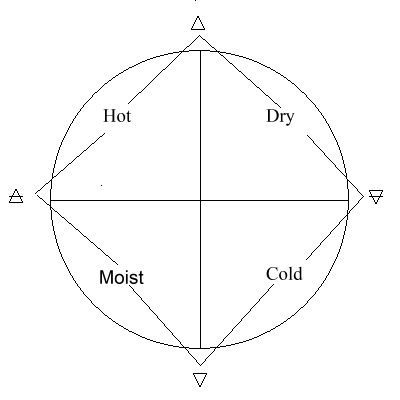
The Four Elements and Their Fundamental Qualities
The diagram above suggests some ideas about the nature of each of the four elements:
Air: moist, becoming hot;
Fire: hot, becoming dry;
Earth: dry, becoming cold;
Water: cold, becoming moist.
[1] Anaximander of Miletus was one of the leading pre-Socratic philosophers. He was born in Miletus at the end of the 7th century BC (610 BC–546 BC).
[2] See https://projetophronesis.wordpress.com/2009/06/17/anaximandro-de-mileto/
[3] Empedocles of Agrigentum (495 BC–430 BC) was a Greek pre-Socratic philosopher and thinker and a citizen of Agrigentum, Sicily.
Add comment
Comments